Saturday, 7 March 2015

Prostitute Mother Suffocates Son

A woman who had no desire to see her infant son live was charged with murder after he died of suffocation but she was fortunate to be convicted only manslaughter.

In 1866 Mary Edwards, a woman who funded her intemperate habits through prostitution, lodged with Jane Kennedy at a court in Blake Street off Copperas Hill. She had given her 21 month old son Joseph to another woman named Hayes to look after but when she demanded money from Mary and she refused to pay, the child was then returned to the mother.
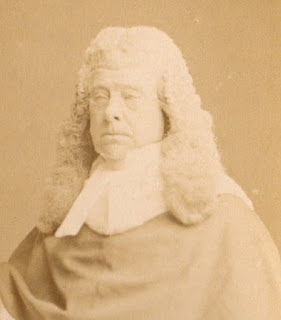
Baron Martin
It was clear that Mary had been mistreating her son before giving him to Hayes, as the collarbone was broken and legs crippled up. When she took the child back, Mary implied that he would not live for very much longer as she would not rear him for his father. For a month or two Mary rarely fed him and left him undressed for long periods, on one occasion making him sleep on the floor while a cat was in the bed. When Jane tried to intervene and give him food herself, Mary would stop her.

On the morning of 27th April Jane pleaded with Mary to dress her son but she didn't and went out instead. On her return Jane left the house and at around 3pm a visitor named Elizabeth Williams called around, finding Mary and Joseph, who had a cloth over his face, lying on the sofa. The visitor left and was followed by Mary soon after, then at 4pm Jane returned and found that Joseph was dead, still with the cloth over his face. When she was taken into custody Mary implied that she had intended to cause death, telling the officer 'Its very hard for me to lose my life for the sake of that child.'

A post mortem confirmed that the cause of death was suffocation and that there were a lot of bruises on the body. The surgeon concerned felt that Joseph was in such a weak condition that it would not have taken long to cause death. At the inquest on 30th April, the Deputy Coroner Mr Wybergh commented that Mary had 'made a great determination to cause death' and that there was 'such a degree of malice present' that a committal to the assizes for wilful murder was appropriate.

Mary was committed to the assizes for a trial which took place on 10th August. Mrs Williams and Jane Kennedy gave evidence, whilst the only defence that Mary could put forward was that she was under the influence of drunk on the day of the death. Despite what seemed to be a clear motive and premeditation, the judge Baron Martin directed the jury to return a verdict of manslaughter. In sentencing her to ten years penal servitude, he said that the crime was as near to murder as possible.


Friday, 6 March 2015

Mother Beaten to Death in Front of Lodger

A man who beat his mother to death as a twelve year old lodger was watching was convicted of murder but had his death sentence commuted to life imprisonment.

Scotland Road in 1908  (www.liverpoolpicturebook.com)
In 1866 Owen McCormick was living with his 65 year old widowed mother Catherine in Thurlow Street off Scotland Road. In the early hours of 19th June that year 29 year old McCormick was in a drunken state in the downstairs of their home, leading to Catherine coming down to check he was ok.

When woken by Catherine, McCormick punched her and stamped on her, pulled her hair and hit her with a poker. He then picked up a boot and started hitting her about the head with the heel of it until it broke. This brutal assault took place in front of 12 year old Mary Hunt, the child of a couple who lodged there.

Mary screamed at McCormick to stop but he threatened her too and she went upstairs, saying nothing to her parents. When daybreak came, she told her father what had happened and he went down and found Catherine in an insensible state. When her condition didn't improve a doctor was called and he discovered four wounds which had cut to the bone as well as serious bruising.

Spencer WalpoleWhen he was taken to the Bridewell on a charge of violent assault McCormick told the police officer that he was 'mad drunk at the time' and knew nothing about what had happened.After Catherine died on 22nd June, a post mortem showed that her internal organs were healthy and death had resulted as a consequence of the injuries to her brain. McCormick was then committed to the assizes on a coroner's warrant after the inquest returned a verdict of wilful murder.

The trial at the assizes took place on 10th August, with the doctor who attended stating that Catherine's injuries were consistent with the beating that Mary had described. The best that the defence could come up with was that the evidence of a 12 year old could not be relied upon to send a man to the gallows.

In summing up the judge said how once again drink was a factor and that he was surprised how people took drink when they had no control of their actions when under its influence. He directed to the jury that if they were satisfied the evidence provided was the truth, then they had to find McCormick guilty of murder.  It took them just a few minutes to return a guilty verdict, but with a strong recommendation for mercy.

When asked why sentence of death should not be passed, McCormick protested his innocence and said that he had gone to bed on the evening of the 18th June after drinking some port, then got up at 630am to find his mother in the state she was in. Baron Martin though had no doubt that the right verdict had been reached and told him prior to donning the black cap: 'The verdict was one that no jury who intended to do their duty could avoid giving. I have no doubt that everything that the girl stated was the truth. It is my firm belief that there was not one word stated by that girl that was not true.'

After the death sentence was passed McCormick cried mournfully and had to be carried to he cells by two turnkeys. However the full sentence of the law was not passed as on 30th August the Home Secretary Spencer Walpole confirmed that he would instead be imprisoned for life.


A Victorian Drink Driver

A drunk shandry driver who knocked over a woman who died was convicted of manslaughter in 1866.

On the morning of Saturday 21st April that year milk dealer Peter Seddon was driving a shandry along Ford Street whilst under the influence of drink and unable to control the gallop of his horse.

A 42 year old woman named Elizabeth Brannon was walking along the causeway and one of the shandry wheels struck her on the shoulder, leading to her falling down. Elizabeth's head hit the kerbstone and she died shortly afterwards.

At the coroner's inquest Seddon maintained that Ford Street was narrow and as such it was solely an accident, but due to the speed he was travelling a verdict of manslaughter was returned.

Seddon was committed to the assizes where he was found guilty on 10th August and sentenced to three months imprisonment with hard labour.

Thursday, 5 March 2015

Son Brings Police to Arrest Father

A boy who witnessed his father assault his mother went out and found a policeman, leading to the arrest of his father and conviction for manslaughter.


On the evening of 9th June 1866 Stephen Carney returned to his Cumberland Street home in a state of drunkenness. The 36 year old then sent his fifteen year son out to get some tobacco, which he began to cut up with a knife after he returned.


Whilst cutting the tobacco Carney got into an argument with his wife Mary and struck her on the forehead. This caused a wound as he had the knife in his hand when he did so. His son, also called Stephen, then went out and found a policeman who took Carney into custody.

A few days later Mary died after erysipelas set into the wound, but the surgeon who carried out the post mortem determined that her constitution was weak due to 'indulgence in intemperate habits.' This led to Carney receiving a sentence of just six months imprisonment with hard labour after being found guilty of manslaughter.

Manslaughter in a Fight

A drinking session between work colleagues got out of hand and left one of them dead and the other imprisoned after a fight broke out.

On the afternoon of Wednesday 2nd May 1866 five men who worked at a cooperage in Edgar Street finished work early and went to a nearby public house, where they drank three and a half gallons of beer between them. They then began playing cards and a dispute arose, leading to 25 year old Patrick Feerick saying to Nicholas Holden 'You and I had better have it right now'.

The two went outside and a fight commenced, but after Feerick was felled Holden then kicked him in the abdomen whilst he was down. Despite this he was able to get back up and carry on, but was knocked down again and this time hit the back of his head on the pavement.

Feerick was taken home where he died the following Tuesday. A post mortem found a ruptured bladder, consistent with being kicked in the stomach. An inquest returned a verdict of manslaughter and Holden was committed to the assizes on a coroner's warrant.

Holden (aged 35) was tried on 10th August and found guilty, leading to a sentence of six months imprisonment with hard labour.

Tuesday, 3 March 2015

Poisoning Death Unsolved

When two sisters died of poisoning just before Christmas in 1856 their mother was found not guilty after the defence failed to prove she had ever had poison or administered it. 

On the afternoon of 20th December that year six year old Margaret Cochrane bought some buttermilk from a shop in St Martin Street. She then went back to the lodging house in the same street where she, her four year old sister Catherine, mother Bridget and father Michael lived. 

Margaret and her sister Catherine each had a cup of buttermilk and some boiled potatoes at about 630pm and were then put to bed by their mother who had spent the day hawking herring. Two hours later a lady who lodged in the room below became alarmed when the ceiling began to fall in and she heard the crackling of fire. As she got up to raise the alarm Bridget was running down the stairs screaming that her children were dead. 

A policeman managed to put out the flames before they spread to any other floor but questioning of Bridget and her labourer husband Michael aroused some suspicions. They gave differing accounts of whether they used candles in the rooms and also couldn't agree on how many children they had. At the inquest on 23rd December lodging house owner Mrs Kelly said that Bridget was screaming that her children were dead even though she didn't appear to have been in their room since the fire started. 

The coroner Mr P F Curry was not satisfied with the evidence and ordered that post mortems be carried out on the bodies of the children. With the inquest being adjourned until after Christmas, Bridget and Michael absconded separately. Two surgeons, one of them from Birkenhead, analysed the stomach contents and found fatal levels of oxalic acid, an irritant vegetable poison.

At the resumed inquest on 5th January the surgeons explained the results of the stomach analysis, saying they had no doubt that poison was the cause of death. Another lodger Mrs Rowlands told how she had not seen Bridget since Christmas Day and Michael since Christmas Eve. The shopkeeper who sold the buttermilk said she had sold a candle as well and that nobody else had complained of the milk making them sick.

Bridget's whereabouts remained unknown but detectives said they had made enquiries at previous places she had inhabited without success. They were able to say that she was well known in Woolton for felony and former neighbours in Stockport had told how she regularly beat and starved the children. Attempts to find out where the poison had been bought though were unsuccessful, oxalic acid being common enough that no druggist would have thought it exceptional to have sold any. 

Mr Curry pointed out to the jury that there seemed no doubt that poison had been administered and caused death, and the setting fire to the room was a 'cloak' to try and conceal the reason for it. There was no proof that Bridget had bought any poison but coincidentally, an earlier child of hers had died in a fire when she lived in Edge Hill and Michael was away in America. A verdict of wilful murder was returned against Bridget and then search for her and her husband continued. 

It was not until early April that the couple were apprehended in the town of Boyle in County Roscommon, Ireland. They were both brought over to Liverpool, but only Bridget was committed to the assizes on a coroner's warrant as Michael had not actually been there when the fire occurred or the girls had tea.

St Martin Street (www.liverpoolpicturebook.com)
On 21st August Bridget appeared before Mr Baron Watson with a baby which she had given birth to in Kirkdale gaol a few days earlier. She was asked if she would like her trial postponed to the next assizes but replied that it would be preferable to have it over and done with there and then. The prosecution case was that she had poisoned the children and then put them to bed before setting fire to it. The motive suggested was that Bridget and Michael wanted to go to America and it would be easier to do this without the children.

Witnesses from the lodging house were called, as were the two surgeons and the shopkeeper. Although there was a lot of circumstantial evidence, the prosecution were still unable to prove that Bridget had ever been in possession of poison, or had the opportunity to mix any into the buttermilk. Under cross examination a surgeon admitted that death could occur anywhere between ten minutes and three weeks after taking this type of poison. The judge then directed the jury to return a verdict of not guilty and 30 year old Bridget was discharged.


Monday, 2 March 2015

Killed Over Broken Cups

A market trader who demanded reimbursement for some cups that had been broken ended up being kicked to death by an angry mob.

On 1st October 1870 Alexander Currie was at his stall on Great George Place when two girls accidentally broke two cups. The 47 year old went to their parents home to get money for the breakages and then returned to the market.

Unknown to Currie, a woman had followed him back to the stall and then wilfully smashed some crockery. When he chased after her into Greenland Street a crowd gathered around and began kicking at Currie, having been told by the woman that he had been abusive about Irish people.

After the beating stopped Currie was taken to the Southern Hospital where he died the following day. A post mortem revealed that he had a fractured skull and that this had been the cause of death. Some witnesses did come forward and two labourers Martin Judge (age 30) and Joseph Welsh (age 17) were charged with manslaughter.

At the assizes on 13th December witnesses were called to state that Welsh was just one of the crowd and did not administer any blows. In doing this though they implicated Judge, but said he had only punched not kicked Currie. In summing up Mr Justice Mellor said that any party who had struck the deceased was guilty of manslaughter even if it had only been a punch not a kick.

The jury found Judge guilty of manslaughter but acquitted Welsh. In sentencing Judge to 5 years penal servitude, Justice Mellor acknowledged that he hadn't struck the fatal blow but did say that 'a person who was being pursued and hooted by a crowd was not to be set upon and beaten with impunity.'