Showing posts with label 1866. Show all posts

Saturday, 7 March 2015

Prostitute Mother Suffocates Son

A woman who had no desire to see her infant son live was charged with murder after he died of suffocation but she was fortunate to be convicted only manslaughter.

In 1866 Mary Edwards, a woman who funded her intemperate habits through prostitution, lodged with Jane Kennedy at a court in Blake Street off Copperas Hill. She had given her 21 month old son Joseph to another woman named Hayes to look after but when she demanded money from Mary and she refused to pay, the child was then returned to the mother.
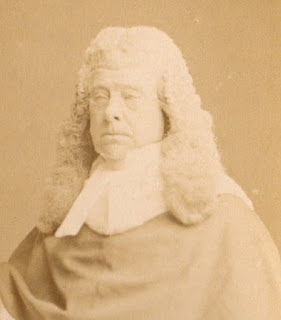
Baron Martin
It was clear that Mary had been mistreating her son before giving him to Hayes, as the collarbone was broken and legs crippled up. When she took the child back, Mary implied that he would not live for very much longer as she would not rear him for his father. For a month or two Mary rarely fed him and left him undressed for long periods, on one occasion making him sleep on the floor while a cat was in the bed. When Jane tried to intervene and give him food herself, Mary would stop her.

On the morning of 27th April Jane pleaded with Mary to dress her son but she didn't and went out instead. On her return Jane left the house and at around 3pm a visitor named Elizabeth Williams called around, finding Mary and Joseph, who had a cloth over his face, lying on the sofa. The visitor left and was followed by Mary soon after, then at 4pm Jane returned and found that Joseph was dead, still with the cloth over his face. When she was taken into custody Mary implied that she had intended to cause death, telling the officer 'Its very hard for me to lose my life for the sake of that child.'

A post mortem confirmed that the cause of death was suffocation and that there were a lot of bruises on the body. The surgeon concerned felt that Joseph was in such a weak condition that it would not have taken long to cause death. At the inquest on 30th April, the Deputy Coroner Mr Wybergh commented that Mary had 'made a great determination to cause death' and that there was 'such a degree of malice present' that a committal to the assizes for wilful murder was appropriate.

Mary was committed to the assizes for a trial which took place on 10th August. Mrs Williams and Jane Kennedy gave evidence, whilst the only defence that Mary could put forward was that she was under the influence of drunk on the day of the death. Despite what seemed to be a clear motive and premeditation, the judge Baron Martin directed the jury to return a verdict of manslaughter. In sentencing her to ten years penal servitude, he said that the crime was as near to murder as possible.


Friday, 6 March 2015

Mother Beaten to Death in Front of Lodger

A man who beat his mother to death as a twelve year old lodger was watching was convicted of murder but had his death sentence commuted to life imprisonment.

Scotland Road in 1908  (www.liverpoolpicturebook.com)
In 1866 Owen McCormick was living with his 65 year old widowed mother Catherine in Thurlow Street off Scotland Road. In the early hours of 19th June that year 29 year old McCormick was in a drunken state in the downstairs of their home, leading to Catherine coming down to check he was ok.

When woken by Catherine, McCormick punched her and stamped on her, pulled her hair and hit her with a poker. He then picked up a boot and started hitting her about the head with the heel of it until it broke. This brutal assault took place in front of 12 year old Mary Hunt, the child of a couple who lodged there.

Mary screamed at McCormick to stop but he threatened her too and she went upstairs, saying nothing to her parents. When daybreak came, she told her father what had happened and he went down and found Catherine in an insensible state. When her condition didn't improve a doctor was called and he discovered four wounds which had cut to the bone as well as serious bruising.

Spencer WalpoleWhen he was taken to the Bridewell on a charge of violent assault McCormick told the police officer that he was 'mad drunk at the time' and knew nothing about what had happened.After Catherine died on 22nd June, a post mortem showed that her internal organs were healthy and death had resulted as a consequence of the injuries to her brain. McCormick was then committed to the assizes on a coroner's warrant after the inquest returned a verdict of wilful murder.

The trial at the assizes took place on 10th August, with the doctor who attended stating that Catherine's injuries were consistent with the beating that Mary had described. The best that the defence could come up with was that the evidence of a 12 year old could not be relied upon to send a man to the gallows.

In summing up the judge said how once again drink was a factor and that he was surprised how people took drink when they had no control of their actions when under its influence. He directed to the jury that if they were satisfied the evidence provided was the truth, then they had to find McCormick guilty of murder.  It took them just a few minutes to return a guilty verdict, but with a strong recommendation for mercy.

When asked why sentence of death should not be passed, McCormick protested his innocence and said that he had gone to bed on the evening of the 18th June after drinking some port, then got up at 630am to find his mother in the state she was in. Baron Martin though had no doubt that the right verdict had been reached and told him prior to donning the black cap: 'The verdict was one that no jury who intended to do their duty could avoid giving. I have no doubt that everything that the girl stated was the truth. It is my firm belief that there was not one word stated by that girl that was not true.'

After the death sentence was passed McCormick cried mournfully and had to be carried to he cells by two turnkeys. However the full sentence of the law was not passed as on 30th August the Home Secretary Spencer Walpole confirmed that he would instead be imprisoned for life.


A Victorian Drink Driver

A drunk shandry driver who knocked over a woman who died was convicted of manslaughter in 1866.

On the morning of Saturday 21st April that year milk dealer Peter Seddon was driving a shandry along Ford Street whilst under the influence of drink and unable to control the gallop of his horse.

A 42 year old woman named Elizabeth Brannon was walking along the causeway and one of the shandry wheels struck her on the shoulder, leading to her falling down. Elizabeth's head hit the kerbstone and she died shortly afterwards.

At the coroner's inquest Seddon maintained that Ford Street was narrow and as such it was solely an accident, but due to the speed he was travelling a verdict of manslaughter was returned.

Seddon was committed to the assizes where he was found guilty on 10th August and sentenced to three months imprisonment with hard labour.

Thursday, 5 March 2015

Son Brings Police to Arrest Father

A boy who witnessed his father assault his mother went out and found a policeman, leading to the arrest of his father and conviction for manslaughter.


On the evening of 9th June 1866 Stephen Carney returned to his Cumberland Street home in a state of drunkenness. The 36 year old then sent his fifteen year son out to get some tobacco, which he began to cut up with a knife after he returned.


Whilst cutting the tobacco Carney got into an argument with his wife Mary and struck her on the forehead. This caused a wound as he had the knife in his hand when he did so. His son, also called Stephen, then went out and found a policeman who took Carney into custody.

A few days later Mary died after erysipelas set into the wound, but the surgeon who carried out the post mortem determined that her constitution was weak due to 'indulgence in intemperate habits.' This led to Carney receiving a sentence of just six months imprisonment with hard labour after being found guilty of manslaughter.

Manslaughter in a Fight

A drinking session between work colleagues got out of hand and left one of them dead and the other imprisoned after a fight broke out.

On the afternoon of Wednesday 2nd May 1866 five men who worked at a cooperage in Edgar Street finished work early and went to a nearby public house, where they drank three and a half gallons of beer between them. They then began playing cards and a dispute arose, leading to 25 year old Patrick Feerick saying to Nicholas Holden 'You and I had better have it right now'.

The two went outside and a fight commenced, but after Feerick was felled Holden then kicked him in the abdomen whilst he was down. Despite this he was able to get back up and carry on, but was knocked down again and this time hit the back of his head on the pavement.

Feerick was taken home where he died the following Tuesday. A post mortem found a ruptured bladder, consistent with being kicked in the stomach. An inquest returned a verdict of manslaughter and Holden was committed to the assizes on a coroner's warrant.

Holden (aged 35) was tried on 10th August and found guilty, leading to a sentence of six months imprisonment with hard labour.

Tuesday, 10 February 2015

Pushed Down Steps to Her Death

A man who pushed his partner's mother died after he pushed her down some steps was sentenced to just two months imprisonment after the judge remarked that although manslaughter it was not an aggravated case.

In 1866 James Wilson and Mary Gilligan cohabited in Christian Street, a relationship that Mary's 50 year old mother Ann did not approve of. On the afternoon of 3rd December Ann and her 14 year old daughter Elizabeth went from their Marybone home to Christian Street and knocked at the door, which was answered by Wilson who told them to go away.

Mary was inside the house with another of her sisters Ellen, who shouted at Wilson to 'turn that old faggot out.' Ann then turned around to go and Wilson grabbed hold of her shoulders and pushed her down the steps, causing her to fall on the pavement. She called out that her leg was broken and was taken to the Royal Infirmary, where a compound fracture was confirmed.

Ann was drunk on admission and remained in hospital and died on 13th December, a post mortem revealing that the kidneys were severely damaged by alcohol abuse. The surgeon who attended to her said that death was hastened by the fall and at the coroner's inquest a verdict of manslaughter was returned.

Wilson was tried just five days later with the surgeon Chauncey Puzey repeating his assertion that Ann would not have died if she didn't have the fall, but also that if she was a healthy lady she would have lived. The jury found Wilson guilty of manslaughter but Justice Smith sentenced him to just two months imprisonment with hard labour, in light of it not being of an aggravated character.

Ship's Carpenter Stabs Fellow Seaman

A seaman who was unhappy about the company his companion kept ended up being jailed for ten years after being convicted of manslaughter.

25 year old William Morgan was a ship's carpenter who arrived in Liverpool from New York on the Aleppo on 29th October 1866. Also on the voyage was George Hill,  and 28 year old Alexander Montgomery, who met the following evening at a coffee house in Old Hall Street. Morgan was not happy about this, believing Dutchman Hill should not be talking to a black man
 who didn't drink alcohol.

After Morgan saw the two men come out of the coffee house he insulted Hill, who struck him. Hill and Montgomery then went into the singing room of Fords public house and Morgan waited for them, offering Hill a fight which was accepted. As the two men got ready to fight Montgomery intervened but Hill told women watching to keep him back. Montgomery persisted in trying to break them up and scuffled with Morgan, who stabbed him in the stomach.

A passing policeman gave chase to Morgan and caught him, while Montgomery was taken to the Northern Hospital. His bowels were protruding and he died about twenty minutes after arrival. A post mortem revealed that all the organs were healthy and death was caused by extravasation of blood in the abdominal area.

Morgan was charged with murder and appeared at the Assizes on 18th December. In summing up Justice Smith said that the jury had to take into account the provocation that had been received by Morgan. This led to  a verdict of manslaughter being returned and Morgan being sentenced to ten years penal servitude.

Thursday, 20 June 2013

Sea Captain Stabbed In Garston


In 1866 a Greek sailor stabbed a captain who was doing a good turn in taking him back to his ship, but avoided a murder conviction due to him convincing the jury he had feared for his safety.

On Sunday 11th February 1866 four sea captains had a quick drink at the Garston Hotel and left at 11pm to return to their ships. Whilst walking to the docks they came across Antonio Patrona, who was clearly drunk and Captain Evan Hughes took his arm and said that he would escort him to his ship, which he did so with the others walking further behind.


Patrona went quietly with Hughes until he reached his ship and then sang in Greek, leading to the appearance of his brother James and another sailor, George Oriata. Very soon afterwards Hughes returned from the quay and fell into the arms of Henry Jones, saying that he had been stabbed. The Patrona brothers ran away but Oriata was quickly arrested, and was identified by Hughes as having kicked him.

When police searched his ship the Antonia, Patrona was unable to produce his knife unlike all the other sailors, telling them 'Me have bad memory.' A knife the same as those belonging to the other sailors on the ship was found the following morning about 20 yards away. Using his Captain as a translator, Patrona claimed that he had acted in self defence after being hit with an umbrella but he was arrested and after Hughes died two days later he was charged with murder and committed for trial at the Liverpool Assizes.

On 31st March Patrona stood trial, a surgeon revealing that Hughes had five stab wounds and that the rupturing of the bowels had resulted in his death. Under cross examination, Hughes's fellow captains admitted they did not actually see what had gone on, only that they had heard a 'scrimmage.' Patrona's defence counsel put it to the jury that he was fearing for his own safety and didn't speak English very well and as such he should only be guilty of manslaughter. After 45 minutes deliberation the jury agreed and also gave a strong recommendation for mercy. Mr Justice Mellor took this into consideration and sentenced Patrona to just nine months imprisonment with hard labour.

Thursday, 13 June 2013

Fined For Killing Omnibus Conductor

In 1866 a bus passenger received an extremely lenient sentence after being convicted of killing the conductor of the omnibus on which he was travelling.

London Road (www.liverpoolpicturebook.com)
On Friday 19th January that year Charles Grice was travelling from London Road to West Derby and boarded the Cabbage Hall omnibus by mistake, soon jumping off at the corner of Moss Street. The conductor John Wardle chased after him and demanded payment of the fare, but Grice said it was ridiculous for him to pay given the distance travelled and pushed him away. When Wardle asked again, Grice pushed him so hard that he fell into the path of another omnibus and had his arms and chest run over by the wheels.

Wardle was taken to the Royal Infirmary where he died from internal injuries at 1am on the Saturday morning. Within hours Grice, a respectable man who ran carriers (a taxi of the time) between Liverpool and West Derby, made his first appearance in court charged with manslaughter and was released on £100 bail.

When he appeared before the Assizes on 2nd April Grice called upon several witnesses to testify to his good character. The jury found him guilty of manslaughter and strongly recommended mercy given Grice had admitted the incident from the beginning and expressed his regret at what had happened. Mr Justice Mellor decided not to imprison him, but instead imposed a fine of £10.

Monday, 10 June 2013

Murder And Suicide in Victorian Old Swan

In 1866 a man murdered his married cousin whilst her husband was away at sea before going on to commit suicide.

Ship's purser Thomas Train and his wife Ann lived at Wood Grove (now hardly in existence as a cul de sac opposite Kwik Fit on Edge Lane). A 20 year old servant named Margaret Golding also lived with them and Ann's cousin John Moss, who had recently returned to Liverpool from Australia where he had made cigars, also regularly stayed there and seemed to have a very close relationship with her.


For two weeks in May 1866 Thomas Train was back with his wife and expressed his disapproval of Moss's presence. At Thomas's request Moss left, but he would visit daily for a meal with Ann while Thomas was visiting Liverpool. On Tuesday 23rd May Thomas set sail aboard the Delamere, leaving Ann with instructions to leave the house in Old Swan and move to a new home in New Brighton. Moss immediately reappeared and stayed for the next two nights, then on Thursday 24th May Ann began packing up for the move, aided by her cousin and servant.


As the three of them were packing, there was a disturbing moment when Moss picked up a carving knife and began to sharpen it, saying that he didn't like this world any more and he could easily kill himself by cutting the jugular vein. By teatime though he was quite calm and after eating they continued packing. At about 930pm Ann asked Margaret to go to another room and get a dress and as she did so she heard screams. On returning upstairs she saw Moss striking Ann with a hatchet. Margaret ran outside for help and came back a few minutes with two neighbours, who found the body of Ann lying on the floor, with part of the brains lying beside the head. Police were called and they searched the house and found Moss's body in the scullery with a carving knife lying beside it, his jugular vein having been cut.


At the inquest into the deaths, it was revealed that a letter had been found in Moss's pocket, apparently written that day and for the attention of Thomas. In it he referred to Ann as 'nearly my sister' and that she was not a 'fit consort' for Thomas and as such he was 'ridding you of her'. The jury returned  a verdict of murder and suicide, having decided that Moss was of sound mind and taken his own life to prevent the law doing it for him.