Showing posts with label death sentence commuted to imprisonment. Show all posts

Monday, 1 July 2019

Shot by a Scorned Woman

In 1896 a woman shot dead a Liverpool merchant who she believed had broken a promise to marry her. She was sentenced to death but was reprieved due to her mental state and spent 55 years in Broadmoor. 


In the early 1890s, whenever Edgar Holland went to London on business, he enjoyed liaisons with Catherine Kempshall, a Sussex born theatre chorus girl. When Holland decided to end the affair, she was furious and sued him for breach of promise in 1895, claiming that he had reneged on a marriage proposal. 
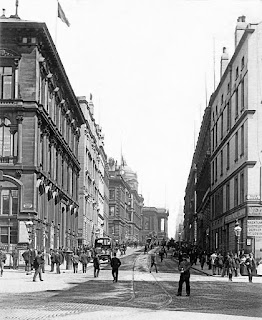
Water Street in 1895 (Liverpool Picturebook)
The dispute was settled out of court by counsel, but Kempshall was unhappy with this as in return for a financial settlement, Holland wanted all letters returned. She successfully applied to the High Court for this agreement to be set aside. In July that year Kempshall represented herself but the judge ruled against her, saying that there had been no promise of marriage.

Kempshall then undertook a year long campaign of harassment against Holland. Taking up lodgings at 40 Irvine Street in Edge Hill she bombarded him with letters. She would often turn up unannounced at his office in Water Street and and home in Penkett Street, Wallasey, where she told his housekeeper that she would shoot him. 

In an attempt to keep Kempshall at bay, Holland occasionally gave her sums of money and wrote saying he was willing to offer a settlement but only if she instructed a solicitor. However she responded by saying that there was no need for her to do so as law was a "thieving profession".

Eventually a meeting was set up between the two at Holland's office at Drury Buildings in Water Street, facilitated by his solicitor Mr Alsop. Holland again told her that although he had no moral or legal obligation, he was prepared to provide for Kempshall but only via a solicitor. She again refused, saying that they were all liars and rogues. Then she took a revolver from under her coat and fired it four times at Holland, the bullets hitting him in the chest, thigh and hand. Alsop bravely ran around the table and pinioned her, causing the firearm to fall from her hand. A policeman was sent for and Kempshall was found to also have a dagger in her possession.

Holland was taken to the Northern Hospital, where surgeons removed a bullet that had penetrated his lung. He was so weak that he was unable to make a deposition and his condition remained critical. Kempshall was taken to the Bridewell where she was charged with attempted murder. A search of her lodgings found further ammunition in a small box. 

Two weeks later, Holland from a collapsed lung. This cause of death was attributed solely to the bullet wound and he was generally considered to be in good health otherwise. This led to Kempshall being committed to the assizes on the charge of murder. 

There was a huge crowd outside St Georges Hall on 19th March the following year as crowds sought admission to Kempshall's trial. She appeared in the dock dressed in all black and wearing a hat and veil. Although appearing weak and distressed, she replied in a firm voice "I am not guilty" when asked to enter her plea. She then undertook an extraordinary tirade in which she insisted the gun had gone off accidentally and called Alsop a liar, before saying she hoped none of the jury were Holland's friends. She had to be told firmly to "shut up" by her counsel.

In opening the case for the prosecution, Mr Pickford said that there was no doubt that Kempshall has shot Holland, with the only thing under question being her state of mind at the time. Alsop was the first witness and he recounted the day of the shooting as well as confirming that a bundle of letters produced, all signed by Kempshall, had all been sent to his office. An employee of Holland said that Kempshall had gone to Drury Buildings on fifteen occasions when he was away on business in Switzerland.

Two doctors testified that Holland's death was solely as a result of the shooting. When challenged on why they didn't operate on the collapsed lung, they replied that he was in too weak a condition and would have died from shock or exhaustion. Maud Park, who had rented a room out to Kempshall at Irvine Street, said that it had been taken under the name of Lock and that she said a solicitor owed her money. Holland's housekeeper was unable to testify due to ill health, and evidence was then heard that Kempshall had spent fourteen days in gaol for slapping the solicitor who represented him in the civil proceedings.

For the defence, the first witness was solicitor William Quilliam who had seen Kempshall in her cell soon after her arrest. He described how she didn't appreciate why she was there, was unable to give coherent sentences and would constantly throw herself back in her seat. Dr Wigglesworth, of the Rainhill Asylum, stated that although Kempshall as sane on other topics when it came to that of Holland, she was suffering delusions that all solicitors and judges were conspiring against her. This, he said, had influenced her conduct as it made her of unstable and excitable temperament. 

Dr Beamish, the Medical Officer of Walton Gaol said that Kempshall had been very weak on arrival and immediately taken to the hospital wing. He was of the opinion that she was suffering from mania persecution as she could discuss other topics calmly but would become excitable at the mention of Holland's name. Another surgeon, Dr Davies, told the court he believed that Kempshall was insane "where Mr Holland was concerned". 

In the closing speech, Kempshall's counsel Mr Madden said that her demeanour in court and words used in the letters showed that her mind was in a disordered state, something that medical professionals had confirmed. She then interrupted however, saying "I am not a maniac, I am quite sane, it is the truth what I say". Drawing his speech to  a close he urged the jury to spare her life as "she knew not what she did".

In his summing up, which lasted half an hour, the judge said that suffering from delusions did not make somebody criminally irresponsible. He told the jury to consider the nature of the delusion and crucially, did it make Kempshall believe that she had to shoot Holland because he was armed himself and about to kill her. At 7pm the jury retired to consider their verdict and after ninety minutes returned to court having found her guilty of murder, but with a strong recommendation of mercy.

Asked if she had anything to say before sentence was passed, Kempshall gave a long speech in a calm and composed manner. She said she had been misled by her solicitors, that Alsop was a liar and that the gun went off accidentally as Holland rushed and tried to dislodge it from her when he saw she had it. There were gasps in court as she said she did not want a reprieve. When sentence of death was passed Kempshall said "He will" in respect of the Lord having mercy on her soul. She was taken to the condemned cell at Walton Gaol where she developed a resigned acceptance to her fate.

A petition was raised by Mr Quilliam at his offices in Manchester Street. Support came from surprising quarters, with Alsop and also Holland's brother Walter both calling for the death sentence to be commuted. A total of 17,796 signatures were gathered and on 31st March a reprieve was granted. This was on the basis of a review of Kempshall's mental state, which concluded that she be removed to the Broadmoor Asylum. Reports stated that Kempshall showed no emotion as she was told of the decision.

Catherine was taken to Broadmoor by train from Woodside on 1st April. She was never released from the institution, dying there in 1952 at the age of 88. 


Sunday, 26 February 2017

Sister in Law Killer Reprieved

A man who cut his sister in law's throat was reprieved from the death sentence.

At around midnight on Saturday 2nd August 1913 Police Constable Monk found a woman lying with her throat cut in Celia Street in Kirkdale. She was 26 year old Jane Wiseman and although she was in a semi conscious state, she was able to say to the officer 'It was my sisters bloke, Griff.'

An ambulance was summoned to take Jane to the Stanley Hospital, where she expired soon after arrival. A police cycle squad was deployed and about two hours later 23 year old William Griffiths was arrested and taken to the Westminster Road Bridewell. On being charged Griffiths, replied 'All I have to say is that it was an accident, I had a row with my father.' 

At a committal hearing on 19th August, Jane's father said that Griffiths had been drinking heavily since drawing some bonus money. He was unable to give any motive for the attack, saying that they had always got on.

At the assizes on 6th November, evidence was presented that showed Griffiths had been outside his home in Braemar Street two days before the attack and shouted 'I will do one of her family.' He had been on shore leave for about three weeks and drinking heavily for most of the time.


In submissions for the defence, Mr Madden said that Griffiths could remember nothing about the crime and that there was no ill feeling between him and Jane. Describing the killing as the result of a 'drunken orgy'. In summing up however, the judge said that by running away and disposing of the razor blade, Griffiths was demonstrating behaviour that indicated he was in control of his actions.


The jury deliberated for half an hour and returned a verdict of guilty but with a recommendation for mercy. Griffiths was sentenced to death, the judge saying that the recommendation would be forwarded.

On 21st November leave to appeal was refused, the judges ruling that the jury had heard all the evidence necessary. Griffiths had worked as a stoker on board the SS Megantic, but his sentence was commuted to penal servitude for life just days before he was due to hang. 


Tuesday, 7 February 2017

Portuguese Wife Killer Repreived

A Portuguese man who shot his wife dead on board a British steamer was sentenced to death but had his sentence commuted to life imprisonment

On 5th February 1914 newly married couple Alberto Coelho and Josephine Quelhas set sail from Lisbon bound for Rio on board the Royal Mail steamer Deseado. The voyage to South America had began in Liverpool. Coelho was a confectioner and also man of substance who owned a substantial amount of property in Brazil. However Josephine had only agreed to go there with him if they were married. 

Justice Bray
Travelling in first class accommodation, they appeared happy but soon it became apparent that all was not well. At around 1230pm on 7th February, when the vessel was 170 miles west of Madeira, Josephine Coelho was sat alone in the social hall. Her husband came in and shouted 'You have made me miserable' before shooting her twice from point blank range. A cellist named Francis Chamberlain pulled Josephine from under the table where she had fallen and found there was a bullet wound in each breast. The ship's surgeon, Dr Segar was called but he confirmed that Josephine was dead and there was no hope of recovery.

Two brave passengers managed to restrain Coelho, who was a well built man, on deck. He showed no resistance as he was put in irons and placed in a guard room. That evening Josephine was buried at sea in a service attended by most of the crew and passengers.

On arrival in Rio two weeks later, Coelho was handed to the British consul who wanted nothing to do with him. He was then taken to a local jail and held there until the Deseado began her return voyage to Liverpool. When the vessel arrived there on 31st March Coelho was arrested and responded through an interpreter 'I intended to kill myself but in Rio they say that I am mad.' Respectably dressed and sporting his thick dark moustache, 32 year old Coelho was initially remanded for a week by magistrates.

The Daily Post reported that Coelho had a dejected appearance as he stood in the dock at the police court a week later. The court first heard that Dr Segar was offered expenses of £3 per day but refused to come from London to give evidence unless he was subpoenaed. The magistrate then gave orders for a summons to be issued. Francis Chamberlain then gave evidence as to Coelho shooting his wife from a range of abut one yard. This was corroborated by a bandmaster named Harry Akers. 

Bernardino Machado
On 14th April the police court proceedings resumed with Dr Segar in attendance. He claimed not to have received a message about attending court then went on to say that death was as a result of a bullet to the heart. Coelho was committed to the assizes for trial and chose to reserve his defence.

Coelho appeared before Justice Bray on 24th April. His defence counsel Mr Rigby Swift did not dispute the facts of the case. Instead, it was suggested simply that no sane man who was happy with his wife could have shot her in broad daylight in front of three or four witnesses. The prisoner's brother Carlos was called to give evidence that he had suffered delusions. He stated that Coelho had neglected his business and often walked aimlessly around Rio saying he was being followed by a large dog. Carlos said that the family were not happy with the marriage to Josephine, who he described as a woman of 'loose character.'

Dr Griffiths from Walton Gaol said that he had not found Coelho to be showing any signs of insanity. Instead he was described as perfectly rational although he had claimed to have no recollection of the killing until he woke up in irons. After an impassioned plea by Mr Rigby Swift that Coelho was not responsible for his actions the jury retired, but after an hour found him guilty of murder. 

On being told of the verdict Coelho replied that Josephine had wanted to put him in an asylum on arrival in Rio. After Justice Bray had passed the death sentence he put his head in his hands and made a remark in Portuguese, before being quickly taken down below.

News of the sentence created shockwaves in Coelho's native Portugal, where nobody had been executed since 1846. On 28th April a demonstration organised by the League of Defence for the Rights of Man in Lisbon was attended by 40,000 people who called upon Prime Minister Bernardino Machado to intervene. He issued a statement however saying that he could not interfere with English law.

On 11th May at the Court of Criminal Appeal Mr Rigby Swift argued that the verdict was unreasonable in line with the evidence. He argued that doctors who had attended to Coelho whilst under guard and in Rio had not been called, but the appeal was dismissed by the Lord Chief Justice who said 'You have no evidence here that the condition of his mind was such that he could not control his actions.'  However he did go on to offer some hope, saying that the Home Secretary had the power to exercise a prerogative and that this was a case he thought fit to do so.

The comments of the Lord Chief Justice were enough to have the execution, set for 14th May, deferred. On that day Joseph Spooner was hanged at Walton Gaol for the murder of his daughter in Edge Hill, but communication was received that Coelho's sentence had been commuted to life imprisonment. 


Friday, 6 January 2017

Handkerchief Killers Reprieved

In 1856 two men were found guilty of killing a man who was found dead in an entry with a handkerchief tied around his neck. However after being sentenced to death they had their sentences commuted on appeal. 

Nile Convict ShipAt 430am on the morning of Wednesday 20th February that year a carter named James Ryan was on his way to tend to his horses in Chisenhale Street. He saw what he thought was a drunk man lying in an entry but he and the stable owner were too afraid to wake him and instead went about their work.

About an hour and a half later Robert Hughes, an apprentice tinsmith, was in the entry and saw the man. He felt the pulse and realised that he was dead, and by chance saw a police inspector and six constables in Chisenhale Street about to come off duty. 

Inspector Duggan examined the body and found that a handkerchief had been tied very tight around the neck. There were also some items of clothing missing, namely boots, coat and braces. The inspector immediately sent for a surgeon while a constable remained by the deceased man's side.

When Dr Sayers from the North Dispensary examined the body, he was of the opinion that as the handkerchief  was double knotted it could not have been an act of suicide. The body was removed to the deadhouse at Princes Dock while detectives immediately began making enquiries in the neighbourhood. This led to the arrest that afternoon of two men, Philip Wall and James Carr, who had been seen by many witnesses with the dead man shortly after midnight. When he was apprehended, Wall was wearing boots that were believed to belong to the deceased, who was identified as a 44 year old local seaman named James House.

The following day an inquest took place before the Coroner Mr P F Curry. After first hearing evidence as to the discovery of the body, a lady called Sarah Brennan was called. She stated that she did not know the victim House, but had seen him a midnight when he was drunk and made a saucy remark to her. Another man then helped him up and then Carr, who she did know, appeared with Wall and the two of them took House down the entry. She swore that House, whose body she had been taken to see in the deadhouse, was the man taken by the two prisoners down the entry.

A woman named Mary Fannin explained that the handkerchief found round House's neck was hers and that she had loaned it to Carr a few weeks previously. Ann Hainsworth, who ran a boarding house in Chisenhale Street, said that Wall had been lodging there about a week and asked her to mind a pawn ticket soon after news of the murder broke. A pawnbrokers assistant then confirmed that Wall had pawned a coat on the Wednesday morning. 

Some damning evidence then came from Michael Hannon, who had a clothes shop in Great Howard Street. He said that he sold some boots to House a week or two earlier and that he was wearing them when he called to the shop just hours before he was found dead. On that visit, he commented on the quality of the boots, bought some more articles and said that he now had enough supplies to go away to sea again. 

John Bold, whom House boarded with when he was not away at sea, confirmed that on the Tuesday night he had been wearing the coat which had been pawned by Wall. Detectives confirmed that on being arrested, Wall claimed to have been given the boots by a seafaring man three weeks earlier. On being told they had been identified as belonging to House, he said they had been given to him by Carr. When Carr was asked about this, he denied all knowledge whatsoever of the boots.

After all the evidence had been heard Mr Curry asked if the prisoners had anything to say. Carr said that he was drunk and couldn't remember anything while Wall said 'one half of the evidence against me is false.' It took just five minutes for the jury to find that House had died as a result of being wilfully murdered by Carr and Wall, who were committed to the assizes for trial on a coroner's warrant.

On 1st April the two men, who were in their twenties and described themselves as seamen, stood trial for their life before Baron Martin. In opening the case for the prosecution, Mr Apsinall said that the evidence was circumstantial, but when it was all pieced together nobody could be left in any doubt as to how James House met his death. 

The first witness called was Mr Bold the lodging house keeper. He restated his evidence of the inquest regarding House's clothing and also that he was sober and had three halfcrowns and two shillings on him at 11pm. The next witness was John Thorn, a victualler from Great Howard Street. He recalled that House had three glasses of wine and some brandy in his premises and was quite tipsy on leaving after midnight. He was accompanied by a woman and said he was joining a ship at Hartlepool the next day, hence his last spree.

The woman who House was with was Jane Hurst, who lived in Chisenhale Street. She described him as 'less than half drunk' and said he walked her home then told her he would be returning to his lodgings. This was at about half past twelve. A police officer called Thomas Newsham then testified that he had seen House, Carr and Wall together on the Chisenhale Street bridge. House was drunk but the other two men said they would look after him and as such Newsham said he had no reason to follow them. Under cross examination Newsham maintained that the drunk man was the same person he had seen at the deadhouse the next day and the two others were the prisoners. 

Sarah Brennan repeated her evidence from the inquest about seeing Carr and Wall take House towards an entry, saying he was their shipmate. This evidence was backed up by Christopher Walker, who had seen House fall against some steps after saying something to a woman, who he said may or not have been Sarah. What he could say though was that Carr and Wall helped him up and took him towards the entry.

Another police officer, James Beattie, recalled seeing the three men in Chisenhale Street and on asking what they were doing, Carr replied that their were going to their lodging house. He waited and saw them knock on a door then went away when a woman leaned her head out of the window. Mary Brophy, the keeper of this lodging house said that the three men had come in and enquired about any available women but left after being told that there weren't any.

The carter Ryan and tinsmith Hughes then recalled seeing House on the pavement, not realising he was dead. Inspector Duggan then testified as to confirming that House was dead and sending for Dr Sayers, who stood and repeated his opinion that death was by strangulation and that it could not have been self inflicted. Mary Fannin confirmed that the handkerchief found around Houses neck was hers and that she had loaned it to Carr. Evidence was then given by Mary Laverty, who owned the house where the two prisoners had gone at about 5am. She told how they got up at about 10am and decided to pawn some clothes to get more drink.

Ann Hainsworth repeated her inquest evidence that she had been given a pawn ticket by Wall, with Thomas O'Brien from the pawnbrokers confirming he had given it out along with six shillings for a coat. Three detectives told how the two prisoners were arrested in Waterloo Road after Sarah Brennan had confirmed the body in the deadhouse was that of the man they had been with. Wall was wearing boots that were later identified as House's, while Carr had in his possession some braces and a comb that belonged to the deceased. The last prosecution witness was clothes seller Michael Hannon, who identified the boots Wall had as the ones he had sold to House, in addition to the coat that was pawned.

The counsel for the prisoners contended that the evidence was circumstantial and neither had any motive to kill House. It was suggested that he had been robbed  of his money by Jane Hurst and later fell down drunk and died. The witnesses were described as infamous and abandoned, and the opinion of Dr Sayers was simply dismissed out of hand. Even if death was a result of violence, the counsel said there was no evidence to suggest the prisoners did it and that it was unsafe to convict them of murder.

Despite the defence pleas, the jury took forty minutes to find both men guilty of murder, but did make a recommendation for mercy. Prior to donning the black cap the judge said 'I do not see how the jury could have come to any other conclusion but that the unfortunate man House came to his death by your hands.' He then passed the death sentence in the usual form and said he would pass the recommendation on, but not make any comment on it. As he was being led away from the dock, Carr said 'I hope it will be the last the bugger will ever sentence.'

Two weeks later, thanks to their defence barrister Mr McDonnell, the sentences for both men were commuted to transportation for life. On 1st January 1858 both men landed in Western Australia after a three and a half month voyage aboard the Nile.


Monday, 26 December 2016

Dead Baby in a Pillowslip

When two boys found a dead baby whilst playing at low tide in the River Mersey, it led to an actress being convicted of murder but reprieved from the death penalty.

On 1st February 1916 two boys, William Williams and Charles Whiteley, were playing below the landing stage at the Pier Head. They noticed a bundle which had a hand protruding from it and on closer inspection found that it was a pillowslip containing the body of a mixed race baby. There was also an iron, which had appeared to have been used to weigh the pillowslip down.

Pier Head in 1907 (www.liverpoolpicturebook.com)
A postmortem showed that the child was healthy and weighed eleven pounds. Death has been as a result of suffocation or drowning. A few days later, twenty eight year old Gertrude Hill, a dressmaker lodging at Cecil Street in Manchester, confessed her knowledge of the crime to her landlady. She said that she had accompanied fellow lodger Beryl Lingard to Liverpool and saw her throw the baby into the river. Hill remarked that she was haunted by this and she kept seeing the little brown legs of the baby, whose name was John. 

The police were called and she made a statement saying that she was present when Lingard placed the baby into a pillowslip, weighted it down with an iron, then threw it into the river. Hill said Lingard had wanted to run but she persuaded her to remain clam so as not to arouse suspicion locally. This led to the arrest on 4th February of Lingard and Hill, who were both taken to Liverpool and kept in custody.

Lingard had led an eventful life. Born in Seville in Spain, she had lost both her parents by the time she was sixteen and gone to Venezuela, where she met a Trinidadian she called Dr Punch. He was the son of a merchant and found her work in films in Australia, then persuaded her to return to Europe where she worked in London and Paris before heading to Manchester. 

In Manchester Lingard found that Punch had another woman with whom he had had a child. However she continued the relationship and after giving birth in December 1915 she and Punch lived at the Blackfriars Hotel, but were told to leave due to constant arguing, a result of Punch's womanising. Punch had then disappeared and Lingard moved to Cecil Street, where she became acquainted with Gertrude Hill.

The two women at the inquest
Hill was initially only arrested on suspicion of being an accessory before the fact but after the inquest and committal hearing on 9th February this was changed to murder. Their trial was set for 24th February when both women appeared together before Justice Bailhache at the Manchester assizes. 

Ethel Mason, the midwife who delivered the baby remembered that Gertrude had said during her labour that if the baby was black then she wanted it killed. Fellow lodgers told how Hill had confessed to knowing about the killing, while the proprietor of the Blackfriars hotel remembered how Lingard was in a pitiable position when she stayed there.

Justice BailhacheA key witness was George Jones, a train guard who recalled seeing the two women on both the outbound and return journeys on the day in question. He explained to the court that on the return journey, there was  a delay at Warrington and when he spoke to the ladies, he asked where the baby was that they had been carrying earlier. They responded that a family in New Brighton was now looking after it and recalled that they had done well to get there and back in time for the return train.

The jury acquitted Hill of all charges but found Lingard guilty of murder, but with a strong recommendation for mercy. She was sentenced to death in the usual way and then taken to Strangeways gaol to await her fate. On 7th March Lingard's solicitor Mr Geddes received communication from the Home Secretary that following his submissions the sentence had been commuted to penal servitude for life.

Monday, 31 October 2016

The Walton Poison Tragedy

A Walton man who poisoned a woman and baby and then tried to commit suicide was convicted of murder and saw his death sentence commuted to life imprisonment. 

In early 1914 Charles Farrow, a bookkeeper and dispenser to two doctors, began living with an old childhood flame Jane Bruce at 86 Chirkdale Street in Walton. In January 1915, thirty nine year old Jane gave birth to a baby girl who they named Mary.

After falling ill and being prescribed stout, Jane took a liking to the drink and began to take it alongside spirits, sometimes drinking a bottle of whisky a day. This led to several quarrels between the couple and in March 1916 Farrow hit out at Jane, kicking her.

Farrow responded to Jane's drinking by gambling heavily and he lost £30 (equivalent to over £2,000 today) on the Epsom Derby. When Farrow failed to turn up for work at Dr Unsworth's surgery in St Anne Street on 5th June 1916 the alarm was raised and police broke into his home. They found him semi-conscious in bed with Jane, who was already dead. Mary was in a bad way too and they were both taken to Stanley hospital. 

After being transferred to Mill Road hospital for further treatment, Farrow was discharged on 15th June and arrested by Detective Sergeant Range. He was charged with murder, attempted murder and attempted suicide and taken to appear before the Stipendiary Magistrate. He responded to the charges by saying that Jane was a drunken woman who gave him provocation and that he then 'felt it better to finish the lot of us.' He admitted giving Jane three ounces of morphia, Mary one ounce then taking four ounces himself. Mary had made a full recovery and been handed over to the care of Jane's sister Mary Kelly.

Farrow was then remanded pending the outcome of the inquest that was scheduled for  Mrs Freeman from number 89 told the coroner that she had witnessed Farrow kick Jane and that her habits had deserved it. Jane's sister said she had visited from her home in Durham the previous Christmas and that the couple seemed comfortable together and fond of their baby girl. Dr Mildred Powell said the postmortem showed that Jane's liver was damaged by alcohol but that death was a result of poisoning. This led to the jury returning a verdict of wilful murder.

On 4th July forty one year old Farrow was committed for trial at the next Manchester assizes, which were about to start. His trial for the murder of Jane took place on 12th July and he offered no defence. Instead Farrow counsel suggested that he had fought a steady fight against Jane's drinking habits for two years and that his mind was disordered due to two years of brainstorm. 

In summing up, the judge Mr Justice Low was not favourable at all to Farrow, pointing out that death by poison was premeditation and that the killing had not been as a result of a sudden impulse. The jury found Farrow guilty, but recommended him to mercy. Farrow was sentenced to death by the judge, but two weeks later this was commuted to life imprisonment by the Home Secretary after representations by his solicitor Dr Geddes.

Thursday, 10 March 2016

Beer Errand Uncovers Murder


A woman who was suspicious of her servant's behaviour discovered the body of a newborn baby after sending her out for beer.

On 24th January 1867 a twenty nine year old named Letitia Dordy took up a position as a servant at 22 Everton Valley, the home of a widow named Eliza Forrest. Soon noticing that her new employee appeared to be in the 'family way' Eliza asked her if this was the case but Dordy replied that it was due to her clothing being out of shape and asked to borrow a needle. A few days later she complained of pains in her side but was better within 24 hours. 

On the morning of 22nd February Eliza went to the kitchen and saw blood on the floor, with Dordy struggling to clean it up. At midday Eliza sent Dordy to get some beer and while she was out of the house searched her bedroom, where she found the body of a newborn girl under the bedclothes. When asked about the find, Dordy admitted giving birth to a stillborn baby the previous night in the coal cellar but was unable to explain the red marks around the neck.

A police constable took the body to Dr Costine in Boundary Street, then to the deadhouse at Princes Dock, while Dordy was allowed to remain at Everton Valley under the supervision of Eliza. The following morning she was arrested on suspicion of murder and taken to observe the inquest.  

Eliza's eleven year old son John and a neighbour deposed to having heard screams at around 8pm on the evening of the 21st February. John stated that he had gone to the coal cellar and asked what was the matter and Dordy told him that she had kicked the cat because it had stolen some cake. Dr Costine told of the post mortem he had carried out, which established that the tongue was swollen, there were marks of external violence and the lungs had expanded. He put the cause of death down to suffocation as a result of violence, leading  to the Coroner's jury returning a verdict of wilful murder.

When Dordy appeared at  the Liverpool assizes on 28th March, the Liverpool Mail reported that she looked sixty years old.  Dr Costine was quite clear in his evidence that he believed the baby had breathed, because respiration had been established in every part of the lungs. This led to Mr Justice Mellor saying in his summing up that Dordy must have known that the baby was alive after the birth. 

The jury found her guilty of murder and she was sentenced to death. Dordy was sobbing violently and almost fainted as she was led from the dock. However a week later the Home Secretary respited the sentence and she was sent to prison in Woking. By 1891 she had been released and was listed in that years census as being back in service, residing in Lambeth.


Tuesday, 17 November 2015

Killing of a Timekeeper

A man who was refused permission to take up his duties after returning to work drunk pushed his timekeeper into the River Mersey. He was found guilty of murder and sentenced to death but later reprieved.


At 6pm on Monday 9th October 1905 William Hitchen, began a nightshift at Toxteth Dock, where the 28 year old worked as a stoker on an engine. At 10pm he was given half an hours break and went with engine driver Thomas Moore to a nearby pub where they both drank one and a half pints of beer. 

Moore returned to his duties but Hitchen stayed away for another forty minutes. When he returned and the timekeeper Thomas Williams refused to book him back on. Williams then left the engine house and walked towards the river, followed by Hitchen. Some words were exchanged and Hitchen pushed Williams over the wall into the Mersey. 

Hitchen then went to rejoin Moore at the engine and casually told him that he had pushed Williams into the Mersey. The driver didnt believe this but a few moments later a labourer went up to him and said that the incident had really happened. Moore ran to the river wall and threw a rope down to Williams who was struggling, but before he could reach it he sank below the water. 

A boat was lowered but the body was not recovered until 2am, by which time Hitchen had fled across the Mersey to his Tranmere home. He was arrested an hour later saying to police 'I am very sorry' when being told that Williams was dead.

An inquest heard that Hitchen's actions had also been witnessed by a labourer named James Murray, who had been told by him 'I will do for that fellow tonight.' Another worker had seen Hitchen in the engine house was was told 'The timekeeper wouldn't book me on but he's alright now, where he ought to be in the river.'

Williams was a 24 year old widower whose wife had died thirteen months earlier. He lodged at 351 Park Road and his funeral was held at St Gabriel's Church followed by an internment at Toxteth Park Cemetery. 

At the Liverpool Assizes on 1st December Hitchen pleaded that he had been drunk at the time, but in summing up Mr Justice Ridley said that this could only be a factor if there had been provocation, which in this case there wasn't. 

The jury took 45 minutes to find Hitchen guilty of murder but with a recommendation for mercy on the grounds of the premeditation period being very short. He had held his head in his hands for much of the trial and fainted on hearing the sentence of death, leading to him being carried from the dock. 

More than 25,000 people signed a petition calling for a reprieve. This was then presented to the Home Secretary by his solicitor John Bateman of 115a Dale Street. Two weeks after the trial, it was confirmed that the sentence would be commuted to penal servitude for life.

Suicide Pact in a Hotel

When two lovers made a suicide pact at a Liverpool hotel, one survived leading to him being sentenced to death.

On Sunday 11th September 1904 a maid at the Waverley Hotel in Lord Nelson Street grew concerned about not being able to enter a room despite making several attempts during the day. At around 7pm the proprietor decided to force entry into the room, which had been booked in the name of Mr and Mrs Muir. On going in they found the female dead and the male alive but unconscious.

When the police arrived the male, 29 year old Allan Muir from Bootle came to but was in a delirious state. He was taken to the Royal Infirmary and then the Workhouse Hospital, where opium poisoning was diagnosed. A search of the hotel room found letters that appeared to indicate a suicide pact between the couple, who were not man and wife but instead two lovers. The female was Isabella Mackenzie, a mother of two from Glasgow who was separated from her husband.

On discharge from hospital Muir was arrested and charged with murder, as the law of the time decreed that if two people attempted suicide and one survived, the other was to be charged with murder. Muir replied to the detective on being told of this charge;  'I did not kill her, we both agreed to die together. She went out and bought the stuff and we both took equal amounts.'

Investigations into the couple's background established that they had met and began a relationship when they were crew members on board the Pretorian, which sailed between Glasgow and Canada. Three days before they were found in the room, they had gone to Muir's home in Bootle where there was a disturbance that led to the police attending. Their last day together had been spent having breakfast in the hotel before buying drugs from chemists in the Lime Street area.

At St George's Hall on 5th December a letter was read out from Muir to his wife, which said 'You have ruined my life with your tongue, you have driven me to this, may god forgive me. I sincerely hope the dear little children will not take after you.' Muir's defence suggested that his lover was a regular taker of opium and that it would have killed her one day, whether or not he was in the vicinity.

The judge's summing up was not favourable to Muir, as he pointed out that Mackenzie had wrote a letter to her husband begging forgiveness, indicating that she was planning to die. The jury returned a guilty verdict but with a recommendation for mercy. The judge passed the death sentence was was the norm but a week later the Home Secretary commuted this to penal servitude for life.


Saturday, 1 August 2015

Wronged Cook's Death Sentence Commuted


A man who killed his wife and her lover after he found out that they were living together was sentenced to death but had the sentence commuted to life imprisonment.

Frank Smart came to Liverpool from the West Indies in 1947 and married his wife Cassie in 1951. They took lodgings in Berkeley Street in Toxteth in April 1956 but two months later somebody else at the house told Smart that every time he worked late as a cook, another West Indian named Fitzy Rattan would be in their room.


Berkley Street in the 1960s (www.liverpoolpicturebook.com)
When Smart confronted his wife and Rattan about this they replied that all they were doing was listening to records. But on 1st July without warning Rattan told Smart that if he ever laid a finger on his wife he would kill him then the following day she went missing. When this was reported to the police, all her clothes were found in a suitcase in Rattan's room. They were traced to a lodging house in Bootle and Cassie agreed to return to her husband.

After Cassie admitted sleeping with Rattan Smart, was so demoralised that he bought rat poison and iodine, mixed it together then drank it in an attempt to take his own life. This suicide attempt failed but after being discharged from hospital he returned to Berkeley Street to find his wife had again left. 

On the 8th of October Smart headed to Preston, where he took a bus to St George's Road and found Cassie and Rattan in a bedsit along with a friend called Mr Beddoe, who had lunched with them. Taking a knife out of a suitcase, Smart told Cassie to get up and that wherever she went in England he would track her down. Rattan left the room and Cassie got dressed, but he then came back in and said that Smart had no right to talk to her like that. Smart then stabbed Rattan in the chest and when Cassie told him to put the knife down, he waved it up and down, slashing her five times in the chest and neck. 

Cassie ran out and over the road to a grocery shop and an ambulance was called, but she died soon after arriving at hospital from a haemorrhage. Rattan had died instantly and when police arrived at the bedsit, Smart handed himself in saying 'I am the man you want, I shall not give you any trouble.'

When Smart appeared in court the following February wearing a dark suit and white shirt, cutting an imposing figure at six feet tall. As was custom at the time, he was charged only with the murder of his wife. Beatrice Carson, with whom Cassie had lodged in Bootle, said that Smart had grabbed her by the throat and held up a knife saying he would kill her if she didn't return. Mr Nahum, the landlord of the property in Preston, said that Rattan had left the room to get a knife but changed his mind and put it back away. Mr Beddoe told how he had sat there for the whole incident.

When he gave his evidence on the second day Smart said that Rattan had a 'bulldog attitude' and sensing danger, he took the knife out of his suitcase. Rattan then ran into the knife and his wife screamed and believing she was about to hit him with a bottle he held the knife out to stop her. He claimed his mind went blind and he was in a tremor, that all he was trying to do was ward off the blow. When asked why he took the knife from Liverpool to Preston, he said it was because he feared what Rattan may do to him. In cross examination from the prosecution he denied that he had gone to Preston with murder in mind and also that his wife had left him as she was scared of his temper.

On the third day Dr Brisby, the senior medical officer at Walton gaol, gave his opinion that Smart was not undergoing a 'hysterical blackout' as the defence claimed. At the end of the trial the prosecution said that all the evidence pointed to Smart being guilty of murder and that he had confessed to the emergency services that he had done it, something he would not have done if his mind was blank. For the defence, Mr Crichton suggested that Smart would not have intended to kill anybody with a witness present and then made no attempt to cover up the crime. He told the jury that the proper verdict in this case should be manslaughter rather than murder.

In summing up Mr Justice Streatfield said this was a love triangle and somebody had been wronged, but that should not interfere with their judgement as to whether Smart was guilty of murder. After the jury found him guilty of murder, he was sentenced to death. However this was later commuted to life imprisonment. Within two months of his reprieve, Smart had taken his own life, throwing himself from a landing in Walton gaol.

Monday, 22 June 2015

Reprieve For Mother Who Gassed Daughter

A woman who gassed her daughter as she was scared what would happen after her husband was hospitalised was sentenced to death but then reprieved by the Home Secretary.

Shortly after 830am on the morning of  Saturday 13th April 1940 Georgina Cashmere walked up to a policeman on Prescot Road, Fairfield and said that she was in trouble. She told the officer 'My husband is in a mental home and my daughter is going mental so I gassed it.'


The flat above a shop at 168a Prescot Road where Georgina lived was searched and officers found the body of two year old Jane Cashmere in a cot in a bedroom. The 41 year old was taken to Old Swan police station where she said that she did not think she would live long enough to bring Jane up, so had put a tube from the gas ring to her face at 5am that morning. She had then carried the dead body of the girl upstairs to her cot.

A post mortem concluded that Jane had died from carbon monoxide poisoning and on 18th April Georgina was committed for trial at the next Manchester assizes. Submissions were made by the defence that the charge should be reduced to manslaughter but this was overruled.

Georgina had married her husband in 1936 and Jane was born in July 1937. The following year she gave birth to another daughter who died of mastoid at just a few weeks old. The marriage had its difficulties, with Georgina confiding in her sister that her husband made her do things sexually that she should not. She also suspected he may have been abusing Jane, who on one occasion put a teddy bear between her legs and said 'daddy does that.'

The latest admission to hospital followed a number of earlier spells, with Georgina's husband having had previously been in Rainhill and Winwick asylums for periods amounting to nearly four years. She was genuinely scared that Jane may have inherited a mental illness.

Less than three weeks after the killing, on 30th April, Georgina appeared before Justice Lewis and pleaded guilty. The prosecutor Mr H. Rhodes called it 'a very sad case' but the law meant that the judge had no option but to pass the death sentence in the usual form. When he got to the phrase 'hanged by the neck until you are dead' she screamed 'Oh sir don't say that' and as she was being taken down the steps cried 'he doesn't mean it.'

The Home Secretary Sir John Anderson acted swiftly to intervene in the case, commuting the sentence to life imprisonment on 6th May. Georgina died in Broadmoor in 1948.


Sunday, 17 May 2015

Man Returns From Football to Find Son Dead

A man returned home from a football match and found his son dead, having been gassed to death by his wife whose own suicide attempt had failed. She was then convicted of murder but was reprieved from the death sentence by the Home Secretary.

On the afternoon of 11th February 1939 John McAuley, went to watch an Everton reserve game at Goodison Park, a short walk from Ismay Street where he and his wife ran a fish and chip shop. He had gone there after a row with his wife, who was worried about the recent downturn in business. 


On returning at 5pm he found his wife's brother getting no answer at the door. After gaining entry John found the body of his three year old son Eric in the kitchen. Next to him was his wife Margaret, aged 37, who was still alive and between the two of them was a tube attached to the gas stove, which was turned on.

Margaret was taken to hospital where she remained until the following Thursday. On discharge she was arrested and charged with murder and attempted suicide. She told the police in a statement: 'It was desperation that drove me to do it, I am not insane. The baby was asleep in the kitchen so I thought it would be better to do away with myself and take him with me. I am desperately sorry for what I have done.' 

At the Manchester Assizes on 2nd March evidence was given about the unhappy state of the marriage, with Margaret regularly being knocked about by her husband. Margaret was found guilty of murder but with a strong recommendation for mercy. As Mr Justice Stable passed the death sentence he did his best to reassure her as she sat with her head buried in her hands, saying 'You need not be in the least alarmed. The recommendation will be endorsed by myself and you may take it as a matter of absolute and complete certainty you will be reprieved and your case will receive the most sympathetic attention.' 

The judge then asked the warders, whom he had ordered to make Margaret a cup of tea while the jury deliberated, to make sure she was as comfortable as possible. When it was time to leave the dock though she collapsed and had to be carried to the cells. Less than 24 hours later the Home Secretary Sir Samuel Hoare acted upon the recommendation and commuted the sentence to life imprisonment.

Wednesday, 29 April 2015

Boy's Body in Kit Bag

Shortly after the outbreak of World War 2 a seven year old boy was murdered in Liverpool, with the killer putting the body in a kit bag and dumping it under his bed.

Around midday on Saturday 16th September 1939  seven year old John Terence Court (known as Terry) went out to play in Everton Road with his younger brother. The pair soon got separated after John was last seen talking to an eighteen year old mess-room steward named Robert Dillon, who was known to them both.

Everton Road (www.liverpoolpicturebook.com)
When John's mother and father were told of this  they went to  Dillon's home in Godfrey Street (situated where Everton Children's Centre now is) and were told by him that he had brought their son there and sent him away with some cigarette cards. Mr Court then reported John as missing, while Dillon went to the cinema. 

At around 9pm that evening Dillon's mother was in his bedroom and noticed a large seaman's kitbag under his bed and asked what was in it. He immediately confessed to his crime, saying 'I'm sorry mum I went mad.' She informed the police and Detective Sergeant Hooley attended, finding several cuts on the neck of John's body. When he asked Dillon why he had done it he replied 'I don't know what made me do it, I lost my temper, I did not mean to do it.' Terry was buried in West Derby Cemetery. 

Dillon was taken into custody and when he appeared at the police court on 2nd October to be committed for trial a statement was read out from him. This stated that Dillon put his hand over John's mouth as he was looking at some cards. When the boy starred to wriggle, he punched him, then stabbed him in the neck and chest. Dillon had then stripped the body and put it in a bag, before washing the knife in the bathroom.     

On 1st November Dillon appeared at the assizes, where two doctors gave evidence that appeared to indicate he did not know what he was doing. One described the attack, which resulted in twenty stab wounds, as frenzied and the other said it was during a fit and he was unaware of his actions. However, in summing up Mr Justice Stable said that if Dillon was not in control of his mind at the time, then he should not have been in a position to provide such a detailed statement in relation to the circumstances of the killing. After an hour's deliberation, the jury returned a verdict of guilty.

Dillon, who was described as 'dull and backwards' in syndicated press reports, showed no emotion as he was sentenced to death. However, on 27th November the verdict was quashed at the Court of Criminal Appeal and the verdict substituted with one of 'guilty but insane' leading to Dillon being detained at His Majesty's Pleasure.   


Tuesday, 7 April 2015

Terror at Murder Victims Wake

When a man was murdered in Vauxhall Road there was further terror for his friends and family when a floor collapsed at his wake leading to all those present falling into a cellar below.

At 7pm on 30th December 1876 William Grimes and his brother John, both sailors aged 22 and 19 respectively, were walking along Vauxhall Road near the corner with Green Street. A labourer named Simon Finnegan called out to them 'Hey Larrie' and when William replied that they must be mistaken as neither were of that name he said 'It would be different if this were Lightbody Street.'

The brothers' friend Patrick Lynch squared up to Finnegan and said 'Why can't you let us pass without a quarrel', leading to him being punched in the face. Finnegan's companion 21 year old James Young went to kick Lynch who was now on the floor but William pushed him off. Young then drew a knife out of his pocket and plunged it into William's stomach several times. He fell down and said 'Oh God I am gone into the next world.'

William was taken to  a druggists shop and then to the Northern Hospital, where he died at 7am the next morning, at a time when he was meant to be sailing out of Liverpool aboard the Iberian.

Young and Finnegan then ran to the house of Elizabeth Rush in Tatlock Street where Finnegan's mother was visiting. Young was in an agitated state, covered in blood and threw the knife on the fire grate pleading Mrs Finnegan to get rid of it, then said to his friend 'If you are taken first don't snitch upon me.' and 'I'll be hung for this.' Finnegan handed himself in and Young, one of the cornermen who terrorised the streets locally, was apprehended on 2nd January.

On 4th January Finnegan was released from custody when prosecutors opted not to proceed with any charges against him. At the inquest the following day Mrs Finnegan described what had happened in Mrs Rush's house and John Grimes told of the circumstances surrounding the stabbing. A verdict of wilful murder was returned and Young was committed for trial at the next assizes.

On Saturday 6th January 1877 William's body was removed from the Northern Hospital to his mother's home at a court in Gascoyne Street where a wake was held well into the night. The coffin was in a table in the middle of the room with guests drinking and dancing around it but at 2am on the Sunday morning the wooden floor gave way, causing all the guests to fall seven feet into the cellar below, to the horror of those living there.

The coffin smashed to pieces and William's body rolled onto the floor. The occupants of the cellar called the police who arranged the removal of the body to another house in the court. All those present at the wake, with the exception of William's mother and brother, were then ordered to return to their homes.


On 16th March Young's trial took place, the defence counsel suggesting that William and John Grimes were violent men and pointed them both having been in gaol for assaults. Patrick Lynch testified that he struck nobody and all three men were just walking along the street minding their own business, having had just one glass of ale each.  A 12 year old girl named Matilda Hughes gave evidence that she had been sent out on an errand and saw the three men walk past Young, who then produced the knife. She was certain that nobody had struck Young or Finnegan before then.

Mrs Finnegan and Mrs Rush recalled Young's admissions in the immediate aftermath and a surgeon from the Northern hospital stated that William had been perfectly sober when giving his dying deposition. After 35 minutes deliberation the jury returned a verdict of murder but asked for mercy on the grounds of William's previous bad character and that there could have been verbal provocation. Young said to the judge 'Oh Lord spare me have mercy' and then interrupted the judge again with the same words as sentence of death was being passed. He cried for three hours in the cells afterwards but he was later spared by the Home Secretary, his sentence being commuted to life imprisonment on 28th March.

Sunday, 5 April 2015

Mother's Death Sentence Reprieve

A woman who killed her young daughter as she was unable to pay for her upkeep was faced the death penalty but this was commuted to life imprisonment.


In January 1878 Emily Jones, a heavily pregnant 19 year old, came to Liverpool from Chepstow in South Wales. After giving birth she gave the baby girl to a nurse called Mrs Hughes who lived in Beaufort Street and took a position in the Kirkdale Industrial School as a laundry assistant.

After leaving there in March 1879 she took the child back and went to stay with her sister in Bembridge Street, off Wellington Road in Toxteth. On Sunday 30th March Jones told her sister Fanny Clarkson that she was taking the little girl back to the nurse and would pay 2s 6d for maintencance.

On 1st April Fanny was cleaning the room where Jones stayed and moved a box, which she thought unusually heavy. She opened it and found the dead body of the child inside and her husband called the police. Constable Phillips was examining the room when Jones returned from being out looking for work. When asked what she knew about the box she broke down, admitting that she had strangled the child as she was just a poor servant girl and couldn't afford to raise her.

A postmortem confirmed the cause of death was strangulation by tying a chord around the child's neck and Jones was committed for trial at the assizes. Her defence was that she was insane at the time of the killing and her old doctor from Chepstow travelled to give evidence, saying she had suffered fits of mania as a child. However doctors who had seen her in gaol were of the opinion she was of sound mind, leading to her being found guilty and sentenced to death, but with a recommendation for mercy due to her young age.

Jones was due to hang on 18th May alongside Thomas Johnson but a week beforehand her sentence was respited to allow for the Home secretary to look further into the case. On 30th May it was confirmed that a reprieve had been granted and the sentence was commuted to penal servitude for life.

Thursday, 26 March 2015

Bootle Youth Reprieved

A 17 year old Bootle youth sentenced to death after stabbing a man whilst drunk was reprieved on account of his young age.

On the evening of 19th September 1885 Joseph Flynn, a 17 year old boiler scaler had too much to drink and decided to challenge anyone of his own size to a fight. The first person he saw was 25 year old carter named Edwin Pearson who had been to a dancing class in Balliol Road.

Pearson was ready for thee challenge and both men took the coats off, but they were separated by friends. Flynn walked away but without warning he took a pocket knife out and turned back, lashing out indiscriminately before plunging it into Pearson's chest.

Pearson was taken to Bootle borough hospital where he died the following morning. Flynn was in a panic and asked a friend he came across to walk with him so as to avoid detection. At the corner of Derby Road and Church Street this youth left Flynn alone and he took a chance by returning to his home at Mann Street where he was apprehended there in the early hours.

At the inquest Flynn apologised for his actions, saying 'I was mad drunk and did not know what I was doing.' He was then committed to the next assizes, standing trial before Justice Wills on 16th November. The jury found him guilty with a strong recommendation for mercy on account of his youth, but Justice Wills said that 'never before was a more ferocious onslaught committed that led to the death of just one person.'

Saying he would forward the recommendation on, the judge then passed the death sentence in the normal form. It was however commuted to life imprisonment due to Flynn's young age.

Wednesday, 18 March 2015

The Canning Place Tragedy

In 1896 two men were charged with murder after a sailor died after a  stabbing in Canning Place, but one was acquitted and the other had his death sentence commuted to life imprisonment.

On 29th June that year 25 year old Scotsman John Gibbons arrived in Liverpool from Valparaiso and took up lodgings with a Mr Hughes in Cleveland Street.

Gibbons became acquainted with John Hilton and a friend of his called Pritchford. The three men were seen by the lodging house keeper to come and go together on occasions but for some reason, Hilton and Pritchford got into a fight with each other on 11th July. This led to the friendship breaking up and Gibbons seemingly siding with Pritchford from then on.

On 19th July Hilton and Pritchford again fought, with the police having to intervene to separate them. Hilton then went into a house and came out with a poker with which he threatened Gibbons, saying he was 'just in the right neighbourhood for doing over.'

The following day Pritchford was locked up and held at the Bridewell, where Gibbons went at 9pm with some tea for him, accompanied by a lady called Mary Goodwin. As they were returning, they encountered Hilton stood on Frederick Street along with a new acquaintance of his called Richard Williams, who showed them a knife and asked Gibbons if he wanted some of it.

Mary began to walk away, leading to Hilton running after her and hitting her in the face. When Gibbons went to push him off Williams came up to him with the knife and said 'you dont interfere.' Hilton was said to have shouted 'stick it in Dick' and Williams plunged the knife into Gibbons's left breast, penetrating the heart.

Both men ran away and Gibbons was already dead when an ambulance arrived. Mary thankfully knew the names of the two offenders and they were arrested in the early hours of the morning. There were various reasons put forward by local sailors for the ill feeling, ranging from one of the men owing money to a dispute having carried over from another port.

At the assizes on 5th August there was conflicting evidence as to the words used by Hilton just prior to the stabbing, leading to his acquittal. With respect to 22 year old Williams, his defence counsel said he had no motive to kill or any previous ill feeling with Gibbons so a manslaughter verdict was more appropriate. In summing up though Justice Cave said he could see no grounds for the lesser verdict, meaning Williams was found guilty of murder and sentenced to death. This was later commuted to life imprisonment by the Home Secretary.