Showing posts with label 1906. Show all posts

Wednesday, 13 February 2019

Canada Dock Tragedy

A man who went to the aid of a crew member on board a ship berthed in Canada Dock died from stab wounds, leading to the assailant being convicted of manslaughter. 

At about 10pm on 6th November 1906 Wallace Tate, from Loxdale Street in Dingle, went to see off a relative on board the steamer Manchester City. The Manchester Line vessel was due to sail at 2am for Buenos Aries. Whilst there he witnessed an altercation between able seaman John Wells and the boatswain, after Wells had refused orders to go on deck.  
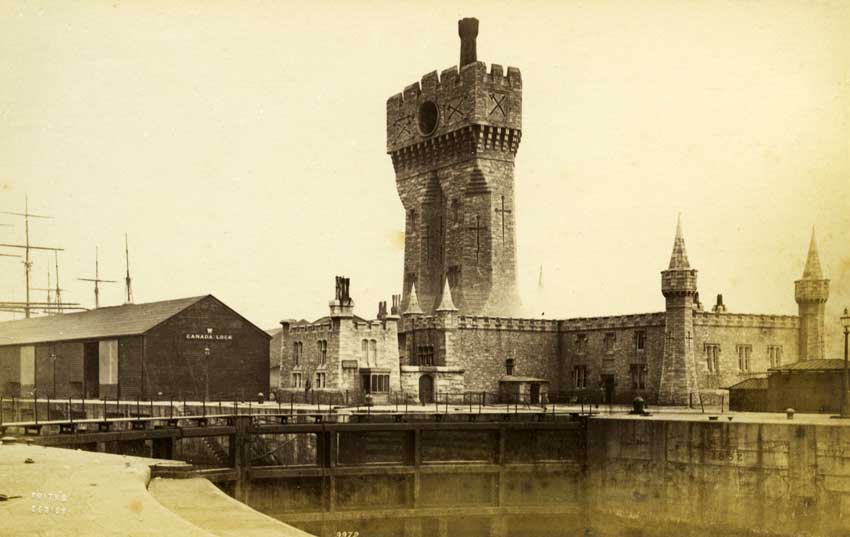
When Wells assaulted another crew member called Driscoll that had stood up for the boatswain, Tate went to break things up. There was a brief struggle and Wells ran off throwing a knife away as he did so. Driscoll had a stab wound in the hand but Tate appeared unhurt and went to sit on a bunk. However a few minutes later he doubled up and fell unconscious on the floor. He was rushed to Stanley Hospital where it was confirmed he had died from a severed artery near a wound on the groin.

Twenty nine year old Wells, who lived in Greenside off Brunswick Road, was arrested on the quayside and appeared before the Police Court the following morning. He said he could recall nothing of the incident, having been drunk. He was then committed to the assizes charged with wilful murder.

Wells appeared before Justice Sutton on 3rd December, where the prosecuting counsel pursued the capital charge on the basis Wells was not acting in self defence. However due to his having been drinking, there being no previous animosity with Tate and the very short premeditation period, he was found guilty only of the lesser charge of manslaughter. Wells was then sentenced to five years penal servitude. 

Wednesday, 11 April 2018

Dental Extraction Gone Wrong

When a seaman died after fighting with a fellow crew member, no charges were brought about when it was found the death was a result instead of a failed dental procedure. 

The Balasore, courtesy of State Library of South Australia
 - PRG 1373/13/32
On 17th November 1906 the Balasore of Eyre, Evans & Co arrived in Liverpool from San Francisco. One of the shipmates, a 23 year old Barbadian named Samuel Archer, was taken to hospital feeling ill and died later that day. 

Enquiries established that during the voyage Archer had been in a fight with Italian Luigi Cocini and received a broken arm as well as broken teeth. Towards the end of he voyage, Archer had asked a fellow crew member to extract some teeth, which went badly and resulted in a broken jaw.

A postmortem revealed that Archer died from shock as a result of the broken jaw, and not in relation to injuries sustained in the fight which had occurred on 24th October. As a result of this, an inquest returned a verdict of accidental death and Cocini was discharged.

Monday, 23 November 2015

Mother Who Cut Son's Throat Detained

A Toxteth mother who cut her son's throat was found guilty of murder but insane, leading to her being detained as a criminal lunatic.

In 1906 Hannah Powell lived with her husband Thomas, a journeyman boilermaker, eleven year old son Johnny and fourteen year old daughter Christine in Sussex Street. This was situated in Toxteth off Upper Hill Street, on the site of what is now St Patrick's School. Also living there was an elder daughter named Emily and her husband Bill Brodie.

On the night of Saturday 12th May that year Hannah was found drunk in the street by Emily, who helped her to bed alongside Thomas who was already asleep. Around 730 the following morning Christine was woken by screams and saw John on the bed next to her with blood spurting out of his throat. She ran upstairs to fetch Emily, who found a bloodstained razor outside the room.

Hannah had by now left the house, shouting to neighbours that she had cut Johnny's throat as her husband had been nagging her all night. Emily's husband Bill went in search of Hannah and found her in Northumberland Street drinking ginger beer. A policeman who had been called arrived at the scene and Hannah gave herself up. Johnny was taken to the Southern Hospital but he was pronounced dead on arrival, his jugular vein having been severed.

At the Bridewell 52 year old Hannah again admitted what she had done and after appearing before magistrates on the Monday morning she was remanded to Walton gaol. When the trial opened on 3rd August Hannah had to be helped up the stairs from the cells to the dock by two warders. She then spent a minute sobbing before she was able to compose herself to hear the indictment. 

As the prosecuting counsel opened the case, Hannah sat rocking back and forth. There was no doubt that she had killed her son, the only question was to her state of mind at the time. Dr Price from Walton gaol said that he had been examining her since she was taken there, and although she gave coherent answers to questions he could not rule out her being in temporary derangement of mind due to waking suddenly from a drunken sleep. 

In his summing up Mr Justice Kennedy remarked that 'she must have known what she was doing' but also that 'she was subject to slight attacks of melancholia' and had been since another child had burnt to death four years earlier. Without leaving the box, the jury found Hannah guilty of murder but insane at the time of the act. The judge then ordered that she 'be kept in custody as a criminal lunatic until His Majesty's Pleasure be known. Hannah then wept as she was taken back to the cells.

Tuesday, 23 June 2015

Fatal Quarrel on a Blackpool Boat

A boat trip to Blackpool ended in tragedy when a crew member drowned in the River Mersey following a fight on the landing stage.

On Saturday 21st July 1906 Herbert Harris and some friends went on the steamboat Greyhound to Blackpool, but on the return journey a row broke out when he accidentally stood on the toes of a crew member named Austin Gibbons.

Back at Liverpool the row escalated and on the landing stage Harris struck a blow at 21 year old Gibbons who retaliated. As Harris stepped back to avoid the punch, he fell over a chain and into the Mersey.

Gibbons was arrested by police the following day and remanded on a charge of wilful murder but the body of Harris was not recovered until 29th July. An inquest returned a verdict of manslaughter, meaning Gibbons was only on trial for that offence when he was committed to the assizes.

At the Liverpool assizes on 17th December Gibbons was found guilty but strongly recommended to mercy by the jury. He was then sentenced to one months hard labour by Justice Lawrence, who commented that it was a disgrace nobody had tried to save Harris.

Fireman Kills Daughter in Fit of Temper

A row between a man and wife led to their baby daughter being killed by a flying mug but the judge showed mercy when it came to sentencing.

On 26th May 1906 after having had too much to drink fireman Samuel Sweeney began an argument with his wife at their Dublin Street home, leading to him picking up a mug and throwing it at her. Unfortunately it hit their nine month old daughter on the head and she died from her injuries.

At the assizes on 2nd August Sweeney was found guilty but with a recommendation for mercy. The judge told him that he was a hard working man who gave way to temper and drink. However, as he had been on remand for two months he imposed a sentence that would mean an immediate release - seven days imprisonment.

Wednesday, 18 May 2011

Anfield Cemetery Murder

In 1906 A 12 year old boy was strangled to death in Anfield cemetery but the killer saw his sentence commuted to life imprisonment due to his low level of intelligence.


On Saturday 10th March of that year William Armitage of 91 West Derby Road was sent on an errand to Walton by his father, who ran a hairdressers. However William never returned and his still warm body was found by a cemetery labourer at 1.15pm with a handkerchief tied round its neck, which also had a deep wound. 

Police at first struggled to find a motive for the murder, as there was no evidence of any robbery having taken place, only signs of a struggle. It was only after a wide appeal for information that a local shoe-shiner, 34 year old John Rawsthorne was apprehended on 20th March.  Rawsthorne was known as 'soft Johnny' by local youths and was described in newspapers as being a 'half wit' and of 'weak intellect'. Various witnesses came forward to say they had seen him acting suspiciously in the area on the day of the murder, while he also watched William's funeral from a distance, telling one of the ladies who attended that if he had been ten minutes earlier he could have saved him.


Rawsthorne told police that he was living in the Liverpool workhouse at the time of the murder and couldn't have been in the vicinity, but this was proved to be untrue. Witnesses said they had seen him in a farmer's field near the cemetery and also outside Breck Road station on the day of the murder, whilst his landlady said he claimed to have been watching Everton play Sheffield Wednesday at Goodison Park.


At his trial Walton Gaol’s medical officer described Rawsthorne as a ‘mental degenerate’ who wouldn't be able to understand evidence. His defence submitted that he was not capable of distinguishing the quantity of his actions but the jury decided he knew the difference between right and wrong as he carried out his crime. Rawsthorne was found guilty of murder but with a recommendation for mercy and his death sentence was subsequently commuted to life imprisonment by the Home Secretary.